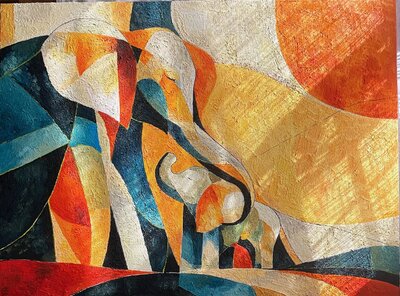
Here is the short answer. The art above your sofa should span 60 to 75 percent of the sofa’s width, hang with its bottom edge 6 to 10 inches above the sofa back, and be centered on the sofa — not on the wall. Get those three things right and the room will look intentional. Get the size wrong, in either direction, and even a beautiful painting will look like it wandered in from another house.
The 60–75% rule, with real numbers
Measure your sofa’s full width, arm to arm. Multiply by 0.6 and by 0.75. Your painting — or the total span of a grouped arrangement — should fall inside that range:
- 72-inch sofa → art 43–54 inches wide
- 84-inch sofa → art 50–63 inches wide
- 96-inch sofa → art 58–72 inches wide
Below 60 percent, the piece starts to float — your eye reads it as decoration that happened to land there. Above 75 percent, it crowds the furniture and the wall feels top-heavy. Inside the range, the painting and the sofa read as one composed unit.
A worked example from our own collection: Matriarch, Jinia’s faceted mother-and-calf elephant painting, is 63 inches wide. Over a standard 84-inch sofa, that is exactly 75 percent — the full, confident end of the range, which suits a single statement piece with nothing else competing on the wall.
Where the 57-inch rule fits — and where it doesn’t
Galleries hang work so its center sits about 57 inches from the floor, average eye level. That rule is right for empty walls, hallways, and anywhere a viewer stands in front of the work. Above furniture, the furniture wins: if centering at 57 inches leaves a 16-inch gap above the sofa back, the painting detaches from the room. Lower it until the gap is 6 to 10 inches. The relationship to the furniture matters more than the absolute height.
The one mistake almost everyone makes
Buying too small. It is more common than every other sizing error combined, and it usually happens because a painting looks large in a photograph or a showroom and small on a real wall. A 36-inch piece over an 84-inch sofa covers barely 43 percent of the width — no arrangement of lamps and cushions will rescue that proportion. When you are torn between two sizes, choose the larger one. Undersized art is the mistake people live with; oversized art, within the 75 percent ceiling, is the one they get complimented on.
Test it before you commit
Cut painter’s tape to the painting’s exact outline and stick it on the wall. Live with it for a day. Check it from the doorway, from the seat opposite, and in evening light. Scale reads differently in a photograph than it does from across a room — the tape test is how you find out which size your wall is actually asking for. Our Interiors pages show each work photographed in a real room setting for the same reason: scale is a thing you should be able to see before a painting ships, not after.
What about height and vertical pieces?
Width does most of the work above a sofa, but height matters too: aim for the painting to occupy roughly half to two-thirds of the open wall between the sofa back and the ceiling. And if your wall is tall and narrow — an entryway, the strip beside a fireplace, a reading corner — a vertical painting will serve it better than a wide one forced into the wrong geometry. Match the orientation of the canvas to the orientation of the space.
Every Jinia original lists its exact dimensions in inches and centimeters, and most are shown in a room setting on their artwork pages. Start with the current collection, measure your sofa, and let the 60–75% rule do the arithmetic.