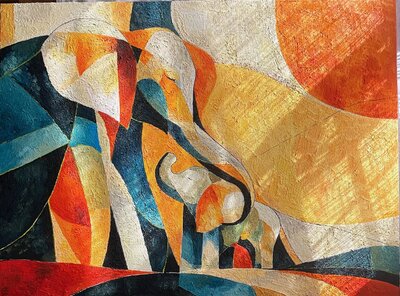
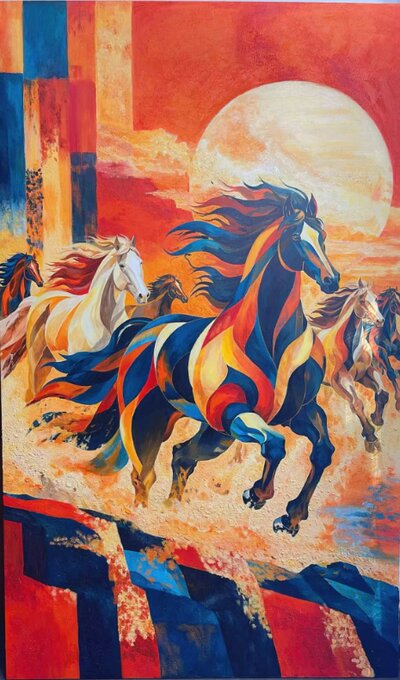
Jinia has painted for more than twenty years, building a body of work around two companions — the elephant and the horse — in a faceted, ember-warm style she calls Ember Figuration. We asked her about the training behind the work, the animals that keep returning to her canvases, and how a painting made of hundreds of facets comes together.
How did you become an artist?
I trained in Chongqing, where I earned my bachelor’s degree in fine art, and I have painted ever since — more than twenty years now. Painting was never a decision I made once; it was the constant everything else arranged itself around. The training gave me the discipline of drawing and of looking properly. The years since have been about unlearning whatever stood between the feeling and the canvas, and keeping the discipline anyway.
Where do you paint?
My studio is in China, and it is arranged around the size of the work. These are large canvases — some taller than I am — so I need wall space to hang them and floor space to step back from them. A painting reads differently from six meters than from sixty centimeters, and I am constantly moving between the two: close enough to touch, then far enough to see whether the animal is really there. I like natural light for judging color. Ember tones lie to you under the wrong lamp.
Why elephants and horses, again and again?
They are opposite kinds of strength. The elephant is strength that shelters — the matriarch whose memory holds the whole family’s map, the adults who circle around the calves. The horse is strength that moves — energy, momentum, a body built for going. Between the two of them I find most of what I want to say about power: that it can protect, and that it can run. I return to them the way you return to people you still have questions for.
Your palette is unmistakable — ochre, crimson, gold, set against deep teal. Where does it come from?
Warmth first. I am drawn to the colors of earth and firelight — ochre, umber, crimson, gold — because they carry heat, and I want the paintings to give a room heat. The teal and deep green grounds are the cool shadow those warm colors need; fire only reads as fire against darkness. Over the years the palette has become a kind of temperature I think in. When a color is too cold, I feel it before I can explain it.
The paintings are built from hundreds of facets. How does a work actually come together?
I call the style Ember Figuration. The figure is not drawn on top of the abstraction — it surfaces from it. I build fields of interlocking facets, warm plane against warm plane, and the animal gradually gathers inside them, the way an image comes back to you in memory: not outlined, but assembled. It means the surface stays alive at every distance. From across the room you read the elephant; from up close, you are inside the masonry of color it is made of.
How has your work changed over twenty years?
Early on, I think I painted subjects. The animal sat on the canvas, correctly drawn, and the painting was about getting it right. Slowly the subject sank into the painting — the facets took over more and more of the work, and the figure became something the viewer completes. I trust the viewer more now. A painting that hands you everything leaves you nothing to do; I would rather leave the last piece of every animal for the person standing in front of it.
How do you know when a painting is finished?
When the animal looks back. There is a moment — it can come after weeks of adjusting facets — when the presence arrives: the elephant is no longer made of paint, it is simply there, and every further touch would only make it more painted and less present. I have learned to stop at that moment, even when parts of the surface still argue with me. Finished is not the same as perfect. Finished is alive.
What do you hope a collector feels, living with one of your paintings?
Company. A painting this size is not decoration; it is a presence in the household, and I hope it behaves like a good one — steady, warm, quietly strong. If someone walks past the elephant each morning and stands a little taller for it, or feels the room hold them a little better in the evening, the painting is doing what I made it to do: hold the wall the way firelight holds a room — quietly, and completely.
Explore the works discussed here in the collections, or read more about Jinia and her practice.