No animal enters a room the way a horse does. A painted horse is never quite still — even standing, it carries the suggestion of the stride before and the gallop after. That stored motion is why horse imagery has been prized from cave walls to contemporary studios, and why a horse painting changes a room’s temperature more than almost any other subject.
What horses stand for
Across cultures the associations cluster tightly. Freedom first: the horse is the animal humans partnered with but never fully tamed, and it reads as wildness that chooses its direction. Momentum second: horses mean journeys, arrivals, ambition — things in motion toward a goal. And power under control: a ridden horse is strength in partnership, which is why equestrian imagery has always belonged to leaders and builders. As with all symbolism, treat these as cultural associations carried by the image — a painting lends a room a feeling, not a fortune. Choose the feeling deliberately.
Jinia’s two horses
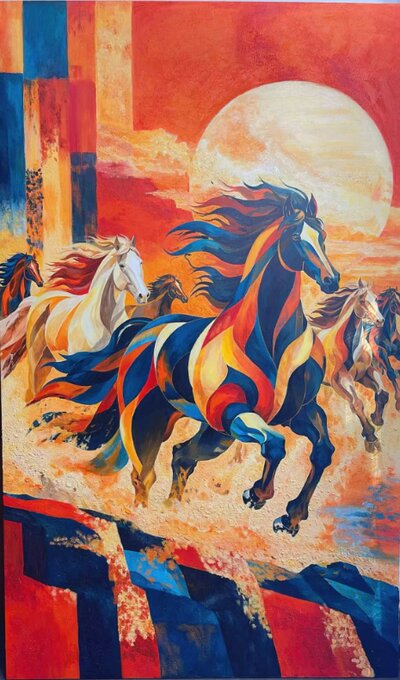
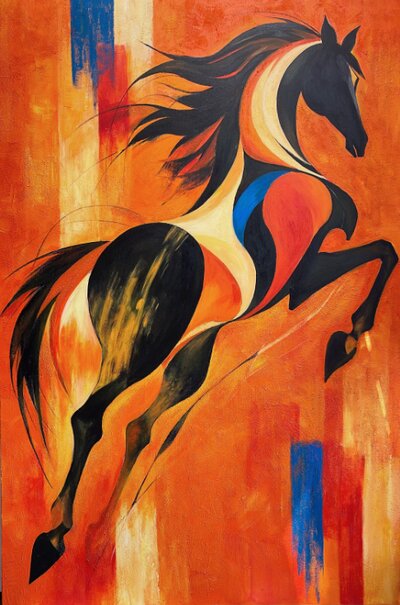
Thunder at Dawn is the dramatic pole: a herd at full gallop under an enormous rising sun, the lead horse striped in navy, crimson and gold like a banner going into the wind — power arriving at dawn, painted at a tall 63 inches to give the charge its full height. Unbridled is the warm pole: a single black horse mid-leap against a wall of flame-orange, its body a banner of cream, scarlet and cobalt. Same subject, opposite weather — one for a room that needs drama, the other for a room that needs warmth in motion.
Where horse paintings work hardest
- Entryways and halls. A vertical horse composition meets guests with momentum — the house feels like it’s going somewhere.
- Home offices and studios. The ambition reading is not subtle, and in a workspace that’s a virtue. It is the rare motivational image that isn’t a poster.
- Living rooms with quiet furniture. If your seating is neutral and low, a charged vertical painting supplies the room’s energy without a single loud cushion.
- Stairwells and tall narrow walls. Vertical horse works were made for the walls other paintings can’t fill — the geometry matches, and the rising stride suits a rising space.
One placement tip specific to horses: give the stride somewhere to go. A horse running toward a corner reads as trapped; the same horse with open wall in front of it reads as free. Direction matters — check which way the horse moves before you choose the wall.
Both of Jinia’s horse paintings are one-of-one originals in the Wild Spirit collection. If elephants are the collection’s shelter, the horses are its weather.