Few animals arrive in a painting carrying as much meaning as the elephant. Across cultures and centuries, elephants have stood for a consistent cluster of qualities — and it is exactly that cluster that makes elephant paintings feel different from other animal art in a home. This is a guide to what those meanings are, and to the rooms where they do their best work.
Memory and wisdom
The elephant’s memory is proverbial because it is real: matriarchs remember water sources, routes, and individuals across decades, and the herd survives on what the oldest female knows. In art, the elephant has become shorthand for that kind of wisdom — not cleverness, but knowledge carried patiently over a long life, and elders whose experience protects everyone behind them.
Family and protection
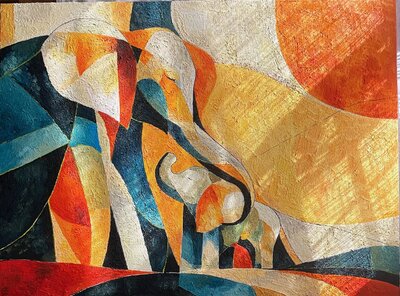
Elephant herds are families, led by a matriarch, and their most famous behavior is the protective circle: adults ring the calves when danger comes. An elephant painting in a family room is rarely just decoration — it reads, even to viewers who never articulate it, as an image of shelter. Jinia’s Matriarch makes the gesture literal: built from facets of teal, gold, and ember, the mother arcs her trunk down around her calf, and the whole composition leans into that curve of protection.
Strength that doesn’t need to announce itself
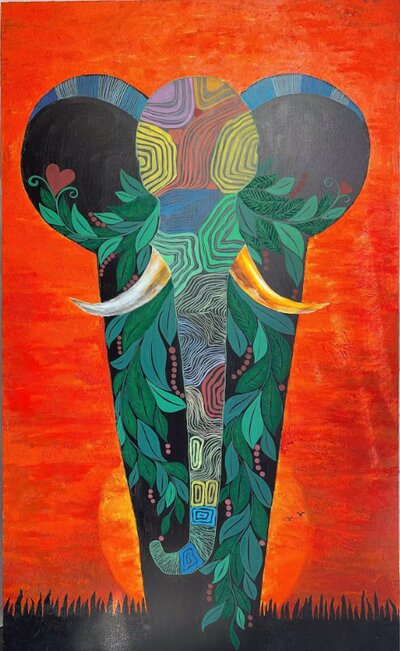
The largest land animal is also, famously, gentle with its own. That combination — power held quietly — is why elephant imagery works in rooms where a more aggressive subject would wear out its welcome. Jinia’s Verdant Guardian pushes the idea furthest: a great frontal face, patterned like carved ornament, overgrown with green vines — strength wearing the garden it protects, with one small red heart hidden high on the ear for whoever looks closely.
A note of honesty about symbolism: these meanings are cultural associations, carried by tradition and story. A painting can’t promise luck or fortune, and you should be wary of sellers who say otherwise. What it can do is put an image in your daily sight that stands for things your household values — which is not a small thing, and is the real reason these paintings have been chosen for centuries.
Where elephant paintings belong
- Living and family rooms. The symbolism and the room agree: gathering, shelter, generations. A wide composition like Matriarch anchors a sofa wall at statement scale.
- Entryways. A frontal, symmetrical work like Verdant Guardian is a natural guardian for a threshold — the first thing a guest meets, meeting them back.
- Quiet rooms and studies. The memory-and-wisdom reading suits rooms built for thinking; choose the calmer, more abstract treatments.
- A child’s room, thoughtfully. A mother-and-calf composition is one of the few statement subjects that belongs there as much as anywhere.
Both of Jinia’s elephant works are one-of-one originals in oil on canvas — Matriarch for the wide, sheltering wall, Verdant Guardian for the frontal, totemic one. Choose by the room, and by which meaning you want to live with.